
The Subject As Freedom
One of the foundational texts of South Asian philosophy, The Subject as Freedom by Krishnachandra Bhattacharya is a profound philosophical inquiry into the nature of subjectivity and the systematic realization of the self as absolute freedom.
- Transcending the traditional boundaries of metaphysics—which typically seeks to understand reality as a “meant” or objective content—Bhattacharya proposes a “spiritual psychology” (or transcendental psychology) that treats the modes of subjectivity as successive stages of freeing oneself from the modes of objectivity.
- The core of the work rests on the distinction between the “Object” (that which is meant and symbolized by the word this) and the “Subject” (that which is intended by the word I).
- Bhattacharya argues that the subject is not a “meant content” but is “incarnated” in the spoken word I, known in itself and felt to be dissociated from the object.
- The book outlines a “cult of the subject,” a disciplined method of cognitive inwardizing designed to retract the self from its identification with the objective world.
- This progression is categorized into three broad stages:
Bodily Subjectivity: The initial stage where the subject is identified with the body, moving from the body as an externally perceived object to the body as internally felt. - Psychic Subjectivity: The realm of “psychic facts,” such as images, ideas, and thought, where the subject begins to distinguish the “presentation” from the perceived object.
- Spiritual Subjectivity: The final stage involving non-presentational consciousness, including feeling and pure introspection, where the subject is realized as a self-evidencing functional fact.
- The ultimate aim of this spiritual discipline is the intuition of the subject as absolute freedom—a state in which the self is no longer characterized by any objective category, including the category of distinctness.
- By methodically reversing the “outgoing reference” to the object, the individual spirit attains a silent, self-enjoying identity that is entirely unobjective and free from the illusions of individuality

About the author
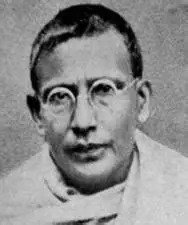
Krishnachandra Bhattacharya (1875–1949) was a distinguished Indian philosopher, educator, and scholar who modernized classical Indian thought by integrating Advaita Vedanta, Sāṃkhya, and Western philosophical concepts while advocating for intellectual freedom and cultural self-awareness.
