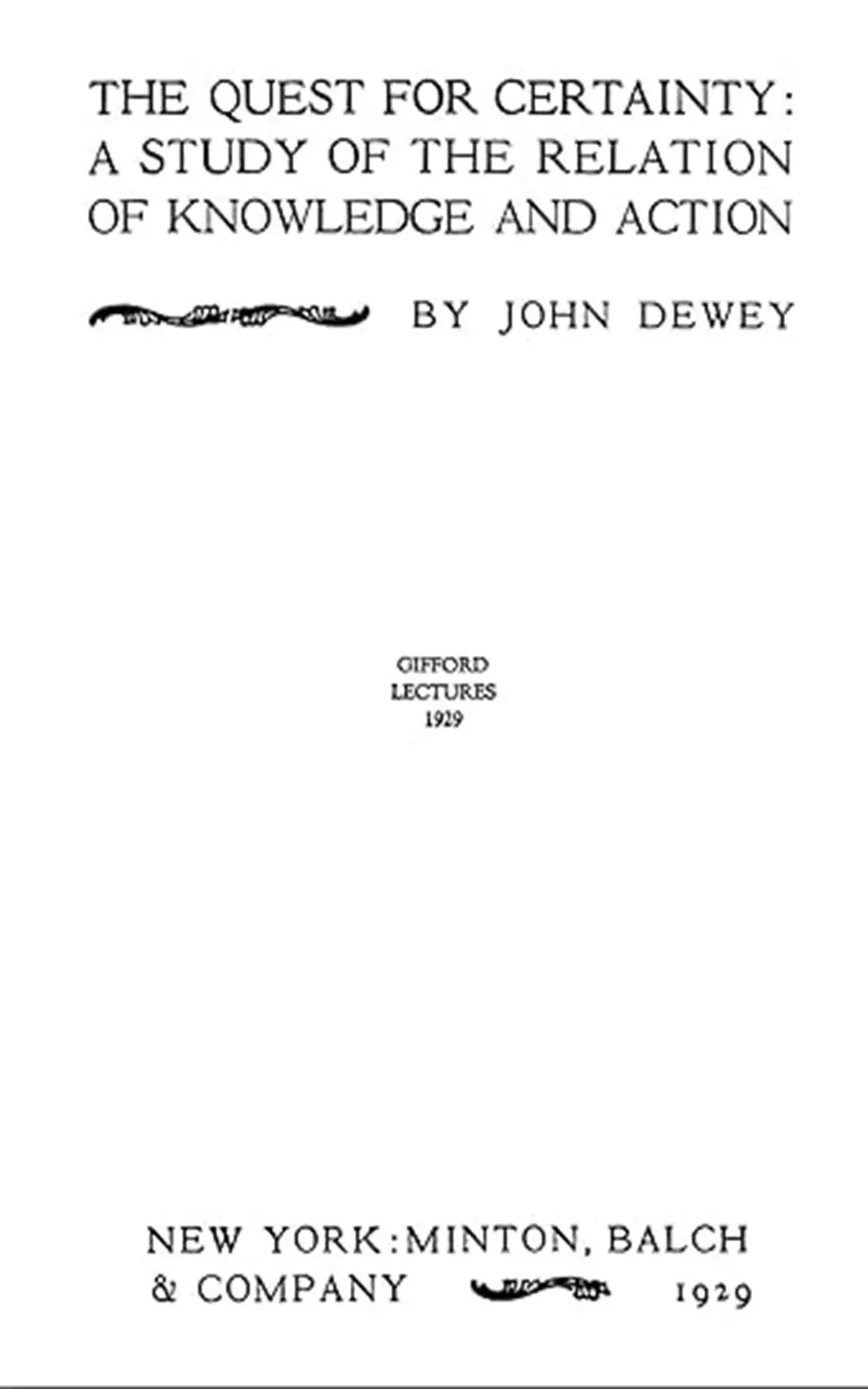
The Quest for Certainty (Annotated 1929 Edition): A Study of the Relation of Knowledge and Action
In “The Quest for Certainty,” John Dewey examines the historical superiority of theoretical knowledge over practical action, arguing that this dualism stems from a primitive human need to escape a hazardous world. He suggests that while ancient philosophy sought security through the contemplation of immutable truths, modern science has fundamentally changed this dynamic by introducing experimental methods that unify thinking with doing. Dewey critiques the “spectator theory of knowledge,” which views the mind as a passive observer of an antecedent reality, rather than an active participant in shaping experience. He proposes that true certainty is found through the intelligent control of natural forces rather than the discovery of fixed, spiritual essences. Ultimately, the text advocates for a reconstruction of philosophy that integrates scientific inquiry with moral values to better secure human goods in an uncertain environment.